30 January 2012

When Uncertainty Lingers

While I may have identified that fear has been keeping me from my studio, it is not the only reason. Uncertainty also plays its part. Not an uncertainty based on fear of failure such as, whether I should paint or whether I am good enough. But uncertainty about what to do with paintings when I am done.


And by that I mean, how do I turn them from painted cloth into a finished artwork*? Should they be stretched and framed? Matted and placed under glass? Or combined with patchwork and stitch to reflect my other creative interests?

 *(That's not to say that all paintings must be finished. Some can just be studies for larger pieces. And some can just be--gasp--failures. But some I do want to finish.)

My instinct has been to add patchwork and stitch. I came to painting through quilting and I want to honor that path. Also, I like the contrast between a painted surface and a pieced/appliqued/stitched surface.

But the question has been: what type of piecing/stitching/applique?

My initial inspiration was the border I added to this quilt started in a class with Robbi Joy Eklow. I liked how the strippy border brought out the colors of the vases.


This weekend I decided to dive in and see what happened. I was feeling a sense of trepidation and that blasted uncertainty. A pep talk from my husband convinced me that all artists have to try things--keeping some ideas and discarding others--and that it was only through the act of trying that I would figure out what I wanted.

I took a painting that I was not thrilled with, figuring that I couldn't really hurt it, grabbed some fabrics that coordinated, and pieced a strippy border. I played for quite a while with border widths, numbers of borders, and so on. I still felt frustrated and unhappy with what I was doing. But I forced myself to make a decision and finally sewed it together.


And when it was done I looked at it and thought "meh." It is pretty, I guess, but staid. I emailed Cynthia with a stream-of-conscious venting of my concerns. She had a couple suggestions and then asked me one question that really made me think,"What does not staid look like to you"

I immediately grabbed my art journal and sat down. I came to a few conclusions:

  • I want to incorporate some type of patchwork/stitching to honor that part of my creative background.
  • I don't want it to feel as though I am just adding a series of static borders. The example above is just static borders. If I just use static borders, I might as well just painet on stretched canvases and use a store-bought frame. There's nothing wrong with that; it's just not what I want at this moment.
  • Most importantly, I want my voice/creativity/hand to continue across the entire piece--from the painting all the way to the outer edge. The finishing needs to reflect my own voice as much as the painting does.
  • Some descriptive words that resonate with me include: layers, fabric, paper-cloth, tattered, raw edges, frayed, stitching, embroidery, applique.
So I decided to embark on a small series of studies to figure it out. I'll paint a number of small 5" squares. And then I'll try different ideas for finishing on each. I'll keep a record of what works and what doe not work, so that I don't have to reinvent the wheel.

I feel a renewed sense of motivation. I'll start today by buying more primed canvas by the yard. Then the rest of the week will be about painting during my spare moments. Next week I'll face the uncertainty and play with different options. I'm really quite excited!

Do you have any suggestions on ways to finish these paintings? Anything you've seen elsewhere that works well? I appreciate any comments or thoughts you may wish to share!

27 January 2012

Back to Imperfect

I haven't blogged in a while. My plan for an imperfect 2012 was to blog more regularly. I haven't. That's alright, I guess, because it is imperfect.

But what isn't alright is why I haven't been blogging. It took a little introspection to figure why, but now that I know, my solution is to put it out there.

And so, I have a confession to make: I'm scared.

Downright terrified.

And immobilized with fear.

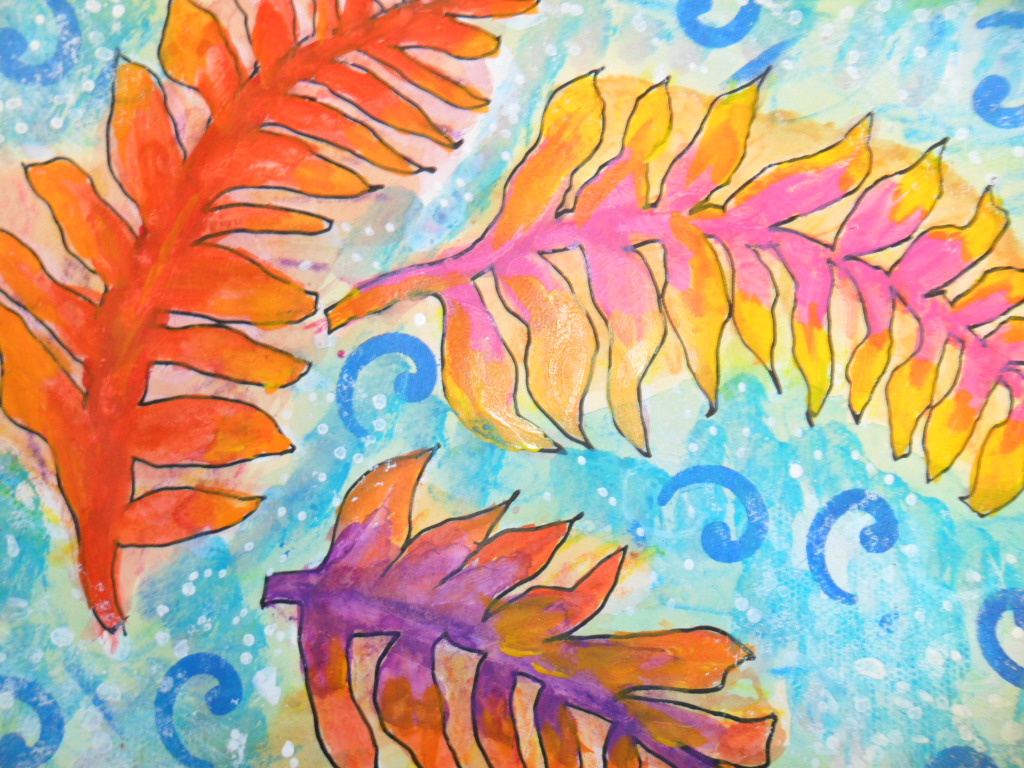
Why so scared? Because a couple weeks ago I went into my studio and painted this:


It was incredibly fun and relaxing and I was so shocked when I was done. It was beautiful to me and I didn't know I was capable of it. I had never really painted before. Sure, I have used paint to make paper-cloth, but that was more a matter of slapping it down to create texture. This was a series of purposeful choices, playing with different paint colors and types of brushes, to create a painting that reflected my voice.

So, a couple days later I painted this:


Again I surprised myself. Over the next week or two, I painted a couple more and each time I felt an incredible satisfaction of self-expression.

And then all of a sudden I stopped. I stayed out of my studio and found other things to do with my time. I wanted to go back and paint some more, but I was resisting. I walked around with a tightness in my chest. I couldn't pinpoint what was going on.

So I grabbed a blank sheet of paper and a scratchy pen (scratchy pens are my writing implement of choice when trying to figure out something) and started journaling. The first couple paragraphs were about everyday worries: why is the cat vomiting again? Why is the car leaking oil? And just how much will fixing the cat and the car cost?

But it wasn't until I turned my thoughts to painting and my studio and art that I began to figure out what was going on. I wrote "Fear. Fear. Fear. I'm so scared right now of what I have done. What if I can't do it again?"

And oh boy did that make everything make sense. Originally, I painted for fun, without fear of failure because "Hey, if I painted something ugly, then that was all part of being imperfect anyway." But as I continued I became attached to the idea of making beautiful things and I lost that freedom of being okay with failure.

So fear struck and resistance formed and I walked around with a lump in my chest as my desire to go paint tangled with my fear of failure.

Once I realized that, it was like finding freedom again. This year is about allowing myself to be IMPERFECT, to make mistakes, to have failures, but to always get up and try again. It's not about clinging so desperately to success that I don't try anything at all.

So back into the studio I go.

And I decided to share this because it's real and honest and imperfect. And maybe it will inspire someone to face their fear that is holding them back.


01 January 2012

A Quick Calendar Quilt

As I have been thinking about my Imperfect theme for 2012, I remembered one very serious plan I had for 2011. My goal was to create a calendar quilt that charted my progress with my very serious goals. I thought hard about how to track days when I was serious about art versus days when I was not. I wanted the calendar to have a different form from the traditional calendar layout. I spent many days drafting different possibilities in my art journal.

But because I was so serious about this calendar, I never actually made a final decision as to what it would look like or what meaning it would convey. After all my very serious thinking, I never actually started the quilt.

I still like the idea of making a quilt over the course of a year; I just no longer worry that it is serious or perfect. So this morning, before I headed to my studio, I made a few quick decisions. First, I would use a traditional calendar layout. Second, I decided that each day's piece would finish at 2.5" x 3.5", which would yield a 17.5" finished block for each month. (The blocks then sashed with 2.5" sashing would finish at 64.5" x 84.5", which is a nice cozy throw size.) Third, I would use a utilitarian fabric like muslin or osnaburg for the empty blocks for each month. Fourth, I would just choose a yummy fabric for each day, regardless of whether I was imperfect about art or not. Fifth, I would break up the heaviness of the prints with a simple white fabric.

Here's a really rough sketch in Electric Quilt of what I envision.  January is the top-left block. The calendar runs in four rows, with December being the bottom-right block.


You are welcome to join me if you like! It's sinple!

1) For each day, choose a fabric and cut a 3" x 4" rectangle from it.
2) Sew each day into a calendar format of seven days a week and five weeks a month.
3) Use a plain fabric for the empty days on the calendar format. (Shown by the grayish blocks on each month.)
4) Sash the block with the same fabric. Cut the sashing strips 3" so they finish at 2.5"
5) After 366 days (it is a leap year!), enjoy the easiest quilt you have ever made!

31 December 2011

On Choosing a Word for 2012

I've chosen my word for 2012. I don't do resolutions, so to speak, but instead choose words that work as my overarching theme for the year ahead. In the past I've chosen things like Say Yes!, Creative Personal Growth, Mindfulness, and Bliss. I find these words are kinder than resolutions and can lead to amazing things.

Last year I chose Serious Art as my word. I chose the word with the best of intentions. This is what I wrote at the time.
For 2011 my theme is Serious Art, which means approaching art in a deliberate and contemplative way and making sure that it becomes part of my daily routine (regardless of how hectic life seems). I'm developing a course of study for the year, for lack of a better term.
I detailed a list of seven bullet points that I wanted to achieve over the year. As I looked back over the year, I realized that I didn't achieve my lofty goals. And I know why.

Serious Art was way too serious. It connected with my traits of competitiveness, thoroughness, procrastination, and perfectionism. I had it all planned out: I would read so many pages a week, create so many pieces a month, connect with so many artists a season. Every step was planned. Every lesson was scheduled. Art would become a second job that I would take seriously.

Which is exactly why I had problems. It didn't exactly fail: I did create nine pieces in a series of nine-patches, I kept an art journal through most of the year, and I took a week-long workshop with Fran Skiles that was absolutely amazing.,

But at the same time, my approach to being serious about art kept me from really creating art. Why? Because my competitive, perfectionist, and procrastinating voices would say "Hey, wait a minute! You're not doing it the right way. You have to be serious about this." Because if I wasn't being serious about my art, then what was the point?

Enough of that.

So as I was thinking about my word for 2012, only one word popped into my head.

IMPERFECT.

As soon as I thought it, I felt a great sense of relief. I knew right then that IMPERFECT is my word for 2012.

Imperfect is messy and fun. It can be beautiful. It requires acceptance (and if I can't accept something, well then that is imperfect too). It's about releasing ridiculously high standards. It's about creating with abandon, giving with joy, and offering myself without shame. Imperfect is liberation.

I've been living this word for the past week and have already noticed changes. For years, my rule has been to have a spotlessly clean house by New Year's Eve. So that has meant the week between Christmas and New Year's has been full of decluttering, vacuuming, dusting, washing floors, and other household chores. But this year that seemed really boring to me. Our house is in pretty good shape generally. And I had so many other fun things that I wanted to do.

So with imperfect in mind, I started asking myself questions. Where did that rule come from? I realized that I created it myself and had carved it into my mind as something that had to be. Did I need to keep it this year? I decided that "No, I don't need to wear myself out cleaning house this year." So I didn't clean. I tidied a bit and kept up with basic chores, but we didn't tear out the closets looking for hidden clutter and we didn't pull out the mop and buckets.

And you know what? Here we are at New Year's Eve and my house isn't spotless and I feel fine. The world has not come to an end!


And I've taken imperfect into the studio. For the past couple days I have played with gesso and watercolor crayons and paint pens and acrylic paints and stencils and stamps to bring an imperfect vibe into my art. I don't want my art to be neat and tidy and perfect. I want it to sing, to be alive, to vibrate with energy. I want it to be full of joy. I want to create it with abandon. And I want to be able to share it without worrying whether it lives up to some standard.

This is a stretch for me. It is more comfortable to be perfect. Because if I am not perfect, then I have an excuse for not showing up. Well, it wasn't going to be perfect anyway, so why bother.

But if the goal is to be imperfect, then I can create with abandon and share without shame.

So without further adieu, may I present to you my first piece of intentionally imperfect art.


I wish you an imperfect New Year, full of messiness and fun and joy and liberation. Step out and create!

27 November 2011

On the Importance of a Single Lampshade to Exercise

Can rearranging furniture lead to a change in a lifetime's thinking about exercise? Oddly enough, the answer appears to be yes.

My husband recently rearranged the family room furniture. He created a beautiful office space for himself within the book-lined walls at the back of the room. But, a consequence is that our treadmill--that once had a perfect view of both the television and backyard--had to be moved. Its new home is an awkward location: you have to walk around it to get to the seating area and the viewing angle for the television and outdoors is uncomfortable. But his new work space is lovely, so I am happy to walk around the treadmill.

We've had that treadmill for many years now. We bought it with best of intentions. We wanted to be able to to exercise regularly, regardless of the weather conditions, while watching whatever we wanted on television. And sometimes my intentions matched reality: I used it regularly while I watched old movies and art quilting programs. But more often it sat lonely and neglected.

The other day I was reflecting on how the winter's loss of light affects me. I am less active and spend less time outside. My energy drags and I can feel low. I decided right then that I would get on the treadmill and see how more consistent activity would counteract the lack of light.

I set the treadmill to a slow speed and started walking. It was a different experience walking on the treadmill in its new home. Instead of a view of the television or backyard, I had a perfect view of a single, white lampshade.

At this point, I need to share something: I have a fairly competitive personality. I was one of those annoying kids in grade school who would race to finish tests first and then invariably get an A. When I was in high school, I was part of a very competitive group of friends who competed over grades, accolades, and awards. Although I was a very good student, the unrelenting competition diminished my desire to compete with others. But it did not mean that I stopped competing with myself.

So when on the treadmill, for example, I would try to better my previous day's result. I would want to go faster, or longer, or on a steeper incline than I did the day before. I'd keep charts of all the statistics--mileage, time, calories burned--and gave myself gold stars for my personal bests.

What would inevitably happen is that I would burn myself out. I'd force myself through tougher and tougher workouts until I was red-faced, sweaty, and out of breath. I'd get shin splints and muscle strains from increasing the difficulty too quickly. Is it any wonder that the treadmill so often sat lonely and neglected?

So there I was, on my treadmill, looking at a white lampshade. I couldn't turn on the television to distract and entertain me while I pushed past my limits. I couldn't let my mind wander as I gazed at the backyard. All I could do was look at a white lampshade. So what I decided to do was to walk very mindfully, using the white lampshade as a focal point.

I focused my attention on how the muscles in my legs felt as I took each step, on how the air felt traveling through my nostrils as I inhaled, and on how it passed through my mouth as I exhaled. Whenever I wanted to look at the display to see how long I had walked or how fast, I would return my attention to the white lampshade. Whenever I wanted to speed up or raise the incline, I would return my attention to the white lampshade.

After walking for a while, I decided that I would stop while I wanted to keep going (rather than keep going until I had to stop). I got off the treadmill, did some simple stretches, and realized how energized I felt by taking it easier (rather than how exhausted I would usually feel after overdoing it).

Walking mindfully changed my experience. That would be my new approach to exercise. I set myself a few simple rules to counteract my natural tendency to compete with myself and also to promote a more mindful experience.
  1. I would set myself a time limit for each session. 
  2. I could stop before I hit the time limit but I could not exceed it. 
  3. I could increase the time limit once a week, but no more than a 10% increase. 
  4. If I had the urge to speed up or increase the incline, then I would slow down or decrease the incline. 
  5. I would get off the treadmill while I still wanted to keep going. 
  6. When my mind wanders I return my attention to the white lampshade.
What it boils down to is that I get on the treadmill because I get on the treadmill. I don't get on the treadmill to walk faster than the day before, or to burn a certain number of calories, or to walk longer than I ever have. I don't have any other goal than to get on the treadmill. The action itself (to get on the treadmill) is the goal (to get on the treadmill).

This has revolutionized my approach to exercise. It's easier to get on the treadmill because that is all I have to do. Once I am on it, I have achieved my goal. Of course while on it, I enjoy the movement and generally walk until the time limit. It's a gentle and mindful approach that allows me to enjoy movement for movement's sake rather than obsessing about pushing past my limits.

I want to reflect more on this idea of doing something because I do it. Can I apply this more mindful approach to other areas of my life? How would my art change if I simply created art for art's sake, rather than with thoughts of gallery shows or sales? How would my writing change if I wrote because I wrote, rather than thinking about who will read it or whether I can be published? Do these goals I set work for or against me? I'll share with you what I discover.

Thanks for reading. I'd love to read any thoughts you might have.

14 November 2011

On Lessons Learned About Hatred

You take your lessons where you find them. When you watch a national scandal develop on your doorstep, it is cause for reflection. The past week has been difficult for this community as it dealt with the ramifications of the sex abuse allegations.The charges are horrific and reflect a serious betrayal of trust. People are at turns angry and disgusted and heartbroken.

While our community has been reeling from the shocking accusations, the national media has swooped in with wall-to-wall coverage. The unceasing reporting has inflamed the entire nation with anger and hatred. First, it was rightfully directed towards the accused. But as the story developed and the details came out, the anger spread outwards--to the entire athletic department, to the university, and ultimately to the community as a whole.

A blog I read regularly had an angry post attacking not just those involved, but the entire Penn State and State College community for valuing football over human life. The commenters began echoing those sentiments in vile terms. I commented in an attempt to show that people here are concerned with the victims and angered by the situation, but it's hard for a single voice to be heard when the mob starts baying.

Over the week, the anger grew even stronger. Vile, hateful comments flooded social media and the internet, wishing death and destruction on the university, the town, and even the entire state. (This is not an exaggeration. You can do a search on Penn State and easily find them.) The students' vigil at Old Main and the alumni's raising of almost $250,000 in two days for a sex abuse charity have been cynically discarded as "public relations exercises" instead of recognizing that it represents the concern of the community. People with no interest in college football gleefully watched the game Saturday in hopes of seeing violence erupt. Instead, I hope their hearts were softened by moving group prayer offered by both Penn State and Nebraska before the game.

Of course there are plenty of reasons to be angry. It's easy to hate in this situation. What happened was so monstrous, so unconscionable, that anger and hatred is understandable and almost impossible to resist. Everyone I've talked to in our community has been extremely angry.  But it's been distressing to watch so much hatred being directed not just at the perpetrator and those whose inaction allowed it to continue, but at this reeling community. So many people are using the actions of a few to malign and attack an entire community of innocent, heartbroken people.

And that has led me to look inward and ask a hard question of myself: do I do the same thing? How often do I read a story that fills me with "righteous anger" that I then allow to spread over an entire community or group of people? The answer shames me because it's more than I would imagine.

It's little comfort to realize that I'm not alone in this. It's an entirely human reaction to divide the world into us and them. And our society encourages that, just read the paper, follow blogs, watch T.V. news, or listen to talk radio. While divisions naturally arise from differences and anger is a normal reaction to cruelty and injustice, you have to nurture these negative feelings to create hatred.

This story is not over for the victims, for the university, or for the community. The weeks and months to come will still be challenging.

So you take your lessons where you find them. After seeing how quickly anger can turn to hatred, I'm going to work hard on my awareness. When I read a story that angers me, I'll acknowledge the anger, but not feed it. When I'm talking with someone and find that conversation is leading down a negative path, I'll check my words and change the nature of the discussion. And when I encounter something that is full of anger and division, I'll close the page or turn it off. It's a small change, but one that I hope can make my little corner of the world a better place.

16 October 2011

On Scary Movies, Soccer, and Mindfulness

I've often wondered why people peek through their fingers during the scary parts of movies. Although I don't watch scary movies much anymore, I can remember covering my eyes during tense moments and looking through the bars of my fingers at the partially-obscured screen. Somehow it makes it better, but why?

A month ago I was curled on the couch watching my favorite soccer team, Liverpool F.C., play Tottenham Hotspur. Within the first five minutes Spurs scored and it was clear that it was not going to be a good day for us. As I watched the game, I realized that I wasn't looking directly at the screen. Instead, I cast my gaze 30-degrees to the right and looked out the patio door, letting the corner of my left eye monitor the game while I gazed at our beautiful Eastern Pine and the blue sky above.

And then two things struck me. First, this is why we watch the scary bits through our fingers; if we're not fully engaged in the movie, if our fingers mediate and restrict our view of the screen, then we don't get as scared.

The second realization is more of a metaphor. My intention was to watch the Liverpool game, but I cast my attention elsewhere. I don't like to see my team lose, so enjoying the view mitigated the dreadful play on the big screen.

But in many ways, this is how we go through life--dividing our attention, never fully mindful of any moment. We drive to work while thinking of what to cook for dinner. We eat lunch while checking facebook. We talk to our spouse while running through a mental to-do list. We do one thing while mentally doing something else. It's like going through life always peeking through your fingers, never fully engaged with the moment.

Mindfulness is continuous awareness of our bodies, emotions, and thoughts, as well as the immediate world around us. When practicing mindfulness, we do one thing at a time and stay present with what we are doing. It is a practice that can lead us to greater peace and understanding.

I use my morning commute as a consistent mindfulness practice. I don't turn on the radio. I don't talk on the phone. Instead I stay present in the moment as I drive. I feel the steering wheel under my hands and notice how the car responds to slight movements. I notice how my body feels: are my muscles tense? did I have enough breakfast? am I thirsty? am I breathing calmly and deeply? I note thoughts and feelings as they occur. With mindfulness practice, I become more aware of the changing seasons and weather: what wildflowers are blooming? what color is the sky? what animals are about? My morning commute becomes rich with awareness as I am reminded each day just how amazing this world is.

The best thing is that even when I slide down the mindless path (and find myself gazing outside while watching a soccer game), I can always start again and return to mindfulness in the next moment.