My beautiful commute takes me past sheep farms, dairy farms, a llama farm, and through some state game lands. I'm very grateful for the quiet country roads that I traverse twice daily. It's a familiar path I've followed for over ten years. Other traffic is minimal--I may encounter a handful of cars along the way--and the driving is pleasant. Once I came across a roving herd of cows. Traffic was barely mooo-ving that day.
It's a twice-daily twenty-minute drive that I enjoy. Because it's so pleasant, I find I can use the driving time productively. Sometimes I practice mindfulness exercises: maybe I look for the color blue in all its hues or maybe I look for things that have changed, which helps me become attuned to the seasons. Other times, I use the time for problem solving. When I'm in the midst of figuring out how to construct the block-of-the-month quilt, I drive around for weeks considering different construction methods and how to write about them. And sometimes, my drive is full of flights of fancy where I let my creative imagination soar.
Last night, as I was driving home, I started thinking about a question that I have been working with for some time: how to incorporate both my painting and my stitching into coherent pieces. I'm enraptured by painting, there's no doubt about that, but I still want to use my stitching. It was through quilting that I found my creative path, so it's important for me to honor and incorporate my stitching background into my work. I'm been trying different ways to meld them both together, but haven't quite found the combination that makes my heart sing.
As I was driving, I began playing with different possibilities in my mind. It was a very fruitful and fast process. The best way I can describe it is that it felt like swiping from one picture to the next on my iPhone: one idea would appear, I would examine and ask questions of it, and then a modified idea would appear. I came home with a handful of potential ideas to try.
And so after a delicious dinner of grilled ribeye and asparagus followed by strawberries and cream (nothing beats seasonal, local eats), I went into my studio and started fooling around with fabric. I started pulling pale shades of aqua and green, which lead me to pale yellows and peaches. I placed them on a piece of felt in a colorwash design and stitched them down using an irregular grid. I grabbed some unpainted paper cloth and cut out a bird and the letters S-O-A-R. I marked them with pencil and then used light washes of acrylic ink to add color. Then I stitched them down. I stretched the piece around an old canvas (learning how to use and load a staple gun in the process) and called it finished.
Stretching the piece around canvas gives it a presence that I like. It has more structure than a flat, floppy quilted wallhanging. It also makes a deeper connection with painting. I need to perfect my folded corners, but that will come.
The other idea I want to try--and I don't think this is the right piece for it--is brushing gloss medium onto the piece after it is stretched. I've played a little with gloss medium on quilted patchwork before and I really like how it confounds expectations: it looks like fabric but is shiny.
As I'm playing with mixing media I'm discovering new perspectives on stitching, painting, and art. It will be interesting to see where future commutes take me.
06 June 2012
01 June 2012
The Artist Formerly Known as Punxsutawney Phil
The creative process is so juicy and lush with possibilities. I love reading blogs by people who open up and share all the fruits of their process--whether it be successes, stumbles, or sidetracks. Reading someone else write "Yay! I just had this great success," or "Hey, you know what? This went wrong for me, but here's what I learned and here's how I'm going to move on from it," or "The project I'm working on is leading me to ask these questions and I'm going to follow that path, even though the destination is unknown," is very inspirational. It's raw and open and honest and I believe that the best art comes from expressing the real essence of ourselves.
But as a blogger, I've taken a more Punxsatawney Phil approach. Every now and then I'll pop up, give a quick status report, and then return to hibernation mode, not to blog again for months. During those months, there are juicy things happening inside my studio and inside me, but I tend to keep them to myself, preferring to only blog when I have things set in my mind.
Over the past few months I have been deeply engaged in painting. I mentioned way back in January that I had started painting and had fallen in love with it. And then I disappeared into my studio not to be heard from again. During that time I took the BIG online painting class with Connie Hozvicka of Dirty Footprints Studio (who I absolutely love and is one of my blogging artist heroes). It's not an overstatement to say that that class radically changed me.
What made the class so real is that the focus was really on process, rather than product. We were encouraged to blog on the class website about our experiences--whether good, bad, or ugly. I had to be mindful of the painting process and pay attention to my internal chatter, listen to what my inner critic saying, and discover when I was being resistant. But it was also about figuring out what was going well and what worked.
It was about sharing my experience and listening to the experience of the other students. Someone would write about their struggles and I would know exactly what they meant. Or I would write about my challenges and someone (most often several someones) would offer me a new perspective that would help me breakthrough.
Going into the class, I made a commitment to myself to participate deeply and share openly about my process with the other students. And so I found that the more honest I was, the more I learned.
And that has made me rethink my blog. I don't want this blog to be a stage showplace, where I pop up every few months, say "Ta-Da," and unveil my latest works. I want it to be as messy and honest and real as my experiences in the studio. That means sharing my process, warts and all. That means sharing my art. In some ways, that scares the daylights out of me. I fear someone commenting, "That face looks weird. Why do you think you can paint?" But the truth is those words truly reflect my own insecurities and struggles with my art.
Today I did something terrifying. I started a new painting last night and this morning I posted a picture of the in-process painting on facebook. And you know what? No one said the face looked weird or that the arms were funny. Those who commented were totally sweet and supportive. And really, even if someone did say something critical, it wouldn't really matter. The reality is: I am learning. But the deeper reality is: I am painting and writing from an open, honest place that reflects the best part of me. As long as I do that--as long as we do that, as long as we work from the deepest, most true part of ourselves, then our work is successful.
And so I will breath deep and share with you my final class project from Connie's class. Are there things I would differently? Are there parts I could improve? Sure, but we can always say that about things. But it's rich with personal symbolism about becoming a painter and living a BIG life. And it comes from an open space in my heart. And so I wish to share that with you.
My deepest wish is that your creative path be fruitful and juicy.
But as a blogger, I've taken a more Punxsatawney Phil approach. Every now and then I'll pop up, give a quick status report, and then return to hibernation mode, not to blog again for months. During those months, there are juicy things happening inside my studio and inside me, but I tend to keep them to myself, preferring to only blog when I have things set in my mind.
Over the past few months I have been deeply engaged in painting. I mentioned way back in January that I had started painting and had fallen in love with it. And then I disappeared into my studio not to be heard from again. During that time I took the BIG online painting class with Connie Hozvicka of Dirty Footprints Studio (who I absolutely love and is one of my blogging artist heroes). It's not an overstatement to say that that class radically changed me.
What made the class so real is that the focus was really on process, rather than product. We were encouraged to blog on the class website about our experiences--whether good, bad, or ugly. I had to be mindful of the painting process and pay attention to my internal chatter, listen to what my inner critic saying, and discover when I was being resistant. But it was also about figuring out what was going well and what worked.
It was about sharing my experience and listening to the experience of the other students. Someone would write about their struggles and I would know exactly what they meant. Or I would write about my challenges and someone (most often several someones) would offer me a new perspective that would help me breakthrough.
Going into the class, I made a commitment to myself to participate deeply and share openly about my process with the other students. And so I found that the more honest I was, the more I learned.
And that has made me rethink my blog. I don't want this blog to be a stage showplace, where I pop up every few months, say "Ta-Da," and unveil my latest works. I want it to be as messy and honest and real as my experiences in the studio. That means sharing my process, warts and all. That means sharing my art. In some ways, that scares the daylights out of me. I fear someone commenting, "That face looks weird. Why do you think you can paint?" But the truth is those words truly reflect my own insecurities and struggles with my art.
Today I did something terrifying. I started a new painting last night and this morning I posted a picture of the in-process painting on facebook. And you know what? No one said the face looked weird or that the arms were funny. Those who commented were totally sweet and supportive. And really, even if someone did say something critical, it wouldn't really matter. The reality is: I am learning. But the deeper reality is: I am painting and writing from an open, honest place that reflects the best part of me. As long as I do that--as long as we do that, as long as we work from the deepest, most true part of ourselves, then our work is successful.
And so I will breath deep and share with you my final class project from Connie's class. Are there things I would differently? Are there parts I could improve? Sure, but we can always say that about things. But it's rich with personal symbolism about becoming a painter and living a BIG life. And it comes from an open space in my heart. And so I wish to share that with you.
My deepest wish is that your creative path be fruitful and juicy.
06 March 2012
On Admitting that I Don't Know How
When I was in the 7th grade, I was one of a handful of students selected to move to the big regional junior high to take advanced classes the following year. This was a big step: it meant leaving my cozy group of 150 classmates, most of whom I had known since kindergarten, for a class of over 500, all of whom would be strangers. I was at turns excited and anxious and proud and terrified. I was excited to have the opportunity to take more classes, uncertain how I would make new friends, and scared that I wouldn't fit in.
During that summer, a routine trip to the mall found me perusing the Young Adult section of Waldenbooks. Amidst the Sweet Valley High books that I collected and the Nancy Drew books I had loved, there was a small paper back titled The Teen Girl's Guide to Social Success. The cover had a a photo of a beautiful blonde glowing in amber light. She seemed sophisticated and popular and grown-up, exactly how I wanted to be.
I cautiously picked up and thumbed through the book, furtively glancing around to make sure no one saw me looking at it. The last thing I wanted anyone to see me reading was a book on how to be popular. It would be a neon light advertising my adolescent insecurity, social awkwardness, and lack of popularity. What twelve year old is willing to admit that?
The more I thought about it, the more I believed that book would be my salvation. I had some babysitting money and thought that $3.95 seemed a miniscule amount to pay for my ticket to popularity, and indeed, my guide to social success. But first I had to make it to the check out.
There were two people working at Waldenbooks that day: an older woman who seemed kindly and a high school student who seemed confident and worldly. I was torn. I wanted to buy the book, but from my perspective, buying it would be an admission of failure. Buying the book would be me telling the world that "I don't know how to be popular. I don't know how to achieve social success." I would rather melt into the beige carpet of the book store than admit to that.
I kept an eye on the register, waiting for a moment when the kindly woman was there by herself. I found my moment and with my heart pounding and cheeks flushing, I walked over and placed the book on the counter. I kept my eyes down while I carefully counted out the cash to pay. The transaction was mercifully brief and I escaped, clutching the bag closely to my side.
At home, I retreated to my room and began reading. Very shortly I realized the book was written for teen girls from a different decade. It answered such pressing questions as what to wear when invited to another school's football game, whether you should bring a hostess gift when invited to a garden tea party, and what fork to use for the fish course. I couldn't bring myself to put it on my bookshelf--again, what if someone saw it?--so I hid it in my sock drawer.
I don't regularly revisit my adolescent angst. That's the great thing about growing up--those things that seemed so important at one point just fade away. And seriously, who would want to go there again? (Which is what I just don't understand about the Twilight series. You are a vampire. Immortal. Over 100 years old. And yet happy to attend high school year after year? Maybe that is what is meant by purgatory.)
While I don't often replay my most awkward moments, I was reminded of it this weekend. Kevin and I took a jaunt to Lewisburg and spent part of the afternoon in the Starbucks at Barnes & Noble. I browsed through the craft books and spent time perusing the drawing books.
Since I have started painting, I realize that learning how to draw would be beneficial. I've taken a drawing class before and know that really, it's a matter of practice and learning how to see. There was a drawing book I hadn't seen before with the encouraging title Learn to Draw in 30 Days. It was written in a friendly style, with fun exercises. It seemed promising. As I sipped my tea, I talked with Kevin and decided to buy it.
I walked back to the art section. (I bet you can see where this is going.) As I picked it up, the briefest thought flashed, "if I buy this book then I am admitting that I don't know how to draw," and I was reminded of that awkward trip to Waldenbooks many years ago.
The coolest thing about growing up is that, instead of quavering under the weight of my own insecurity, I could laugh that thought away. I asked myself, "Seriously, I'm afraid to admit that I don't know how to draw?" And I realized that was ridiculous. As though anyone would care that I couldn't draw. As though anyone would expect me to be able to draw. And as though what anyone else would think even matters.
And so buying that book was merely a routine retail transaction for a grown woman, and not a challenge requiring incredible reserves of bravery from an adolescent girl.
But what I did realize is that learning to draw and becoming a better painter is very important to me. How important? It's as important as learning how to fit in was to my twelve-year-old self. So that's pretty dang important. I better pay attention and put the time in to learn.
During that summer, a routine trip to the mall found me perusing the Young Adult section of Waldenbooks. Amidst the Sweet Valley High books that I collected and the Nancy Drew books I had loved, there was a small paper back titled The Teen Girl's Guide to Social Success. The cover had a a photo of a beautiful blonde glowing in amber light. She seemed sophisticated and popular and grown-up, exactly how I wanted to be.
I cautiously picked up and thumbed through the book, furtively glancing around to make sure no one saw me looking at it. The last thing I wanted anyone to see me reading was a book on how to be popular. It would be a neon light advertising my adolescent insecurity, social awkwardness, and lack of popularity. What twelve year old is willing to admit that?
The more I thought about it, the more I believed that book would be my salvation. I had some babysitting money and thought that $3.95 seemed a miniscule amount to pay for my ticket to popularity, and indeed, my guide to social success. But first I had to make it to the check out.
There were two people working at Waldenbooks that day: an older woman who seemed kindly and a high school student who seemed confident and worldly. I was torn. I wanted to buy the book, but from my perspective, buying it would be an admission of failure. Buying the book would be me telling the world that "I don't know how to be popular. I don't know how to achieve social success." I would rather melt into the beige carpet of the book store than admit to that.
I kept an eye on the register, waiting for a moment when the kindly woman was there by herself. I found my moment and with my heart pounding and cheeks flushing, I walked over and placed the book on the counter. I kept my eyes down while I carefully counted out the cash to pay. The transaction was mercifully brief and I escaped, clutching the bag closely to my side.
At home, I retreated to my room and began reading. Very shortly I realized the book was written for teen girls from a different decade. It answered such pressing questions as what to wear when invited to another school's football game, whether you should bring a hostess gift when invited to a garden tea party, and what fork to use for the fish course. I couldn't bring myself to put it on my bookshelf--again, what if someone saw it?--so I hid it in my sock drawer.
I don't regularly revisit my adolescent angst. That's the great thing about growing up--those things that seemed so important at one point just fade away. And seriously, who would want to go there again? (Which is what I just don't understand about the Twilight series. You are a vampire. Immortal. Over 100 years old. And yet happy to attend high school year after year? Maybe that is what is meant by purgatory.)
While I don't often replay my most awkward moments, I was reminded of it this weekend. Kevin and I took a jaunt to Lewisburg and spent part of the afternoon in the Starbucks at Barnes & Noble. I browsed through the craft books and spent time perusing the drawing books.
Since I have started painting, I realize that learning how to draw would be beneficial. I've taken a drawing class before and know that really, it's a matter of practice and learning how to see. There was a drawing book I hadn't seen before with the encouraging title Learn to Draw in 30 Days. It was written in a friendly style, with fun exercises. It seemed promising. As I sipped my tea, I talked with Kevin and decided to buy it.
I walked back to the art section. (I bet you can see where this is going.) As I picked it up, the briefest thought flashed, "if I buy this book then I am admitting that I don't know how to draw," and I was reminded of that awkward trip to Waldenbooks many years ago.
The coolest thing about growing up is that, instead of quavering under the weight of my own insecurity, I could laugh that thought away. I asked myself, "Seriously, I'm afraid to admit that I don't know how to draw?" And I realized that was ridiculous. As though anyone would care that I couldn't draw. As though anyone would expect me to be able to draw. And as though what anyone else would think even matters.
And so buying that book was merely a routine retail transaction for a grown woman, and not a challenge requiring incredible reserves of bravery from an adolescent girl.
But what I did realize is that learning to draw and becoming a better painter is very important to me. How important? It's as important as learning how to fit in was to my twelve-year-old self. So that's pretty dang important. I better pay attention and put the time in to learn.
30 January 2012
When Uncertainty Lingers
While I may have identified that fear has been keeping me from my studio, it is not the only reason. Uncertainty also plays its part. Not an uncertainty based on fear of failure such as, whether I should paint or whether I am good enough. But uncertainty about what to do with paintings when I am done.
And by that I mean, how do I turn them from painted cloth into a finished artwork*? Should they be stretched and framed? Matted and placed under glass? Or combined with patchwork and stitch to reflect my other creative interests?
*(That's not to say that all paintings must be finished. Some can just be studies for larger pieces. And some can just be--gasp--failures. But some I do want to finish.)
My instinct has been to add patchwork and stitch. I came to painting through quilting and I want to honor that path. Also, I like the contrast between a painted surface and a pieced/appliqued/stitched surface.
But the question has been: what type of piecing/stitching/applique?
My initial inspiration was the border I added to this quilt started in a class with Robbi Joy Eklow. I liked how the strippy border brought out the colors of the vases.
This weekend I decided to dive in and see what happened. I was feeling a sense of trepidation and that blasted uncertainty. A pep talk from my husband convinced me that all artists have to try things--keeping some ideas and discarding others--and that it was only through the act of trying that I would figure out what I wanted.
I took a painting that I was not thrilled with, figuring that I couldn't really hurt it, grabbed some fabrics that coordinated, and pieced a strippy border. I played for quite a while with border widths, numbers of borders, and so on. I still felt frustrated and unhappy with what I was doing. But I forced myself to make a decision and finally sewed it together.
And when it was done I looked at it and thought "meh." It is pretty, I guess, but staid. I emailed Cynthia with a stream-of-conscious venting of my concerns. She had a couple suggestions and then asked me one question that really made me think,"What does not staid look like to you"
I immediately grabbed my art journal and sat down. I came to a few conclusions:
I feel a renewed sense of motivation. I'll start today by buying more primed canvas by the yard. Then the rest of the week will be about painting during my spare moments. Next week I'll face the uncertainty and play with different options. I'm really quite excited!
Do you have any suggestions on ways to finish these paintings? Anything you've seen elsewhere that works well? I appreciate any comments or thoughts you may wish to share!
And by that I mean, how do I turn them from painted cloth into a finished artwork*? Should they be stretched and framed? Matted and placed under glass? Or combined with patchwork and stitch to reflect my other creative interests?
*(That's not to say that all paintings must be finished. Some can just be studies for larger pieces. And some can just be--gasp--failures. But some I do want to finish.)
My instinct has been to add patchwork and stitch. I came to painting through quilting and I want to honor that path. Also, I like the contrast between a painted surface and a pieced/appliqued/stitched surface.
But the question has been: what type of piecing/stitching/applique?
My initial inspiration was the border I added to this quilt started in a class with Robbi Joy Eklow. I liked how the strippy border brought out the colors of the vases.
This weekend I decided to dive in and see what happened. I was feeling a sense of trepidation and that blasted uncertainty. A pep talk from my husband convinced me that all artists have to try things--keeping some ideas and discarding others--and that it was only through the act of trying that I would figure out what I wanted.
I took a painting that I was not thrilled with, figuring that I couldn't really hurt it, grabbed some fabrics that coordinated, and pieced a strippy border. I played for quite a while with border widths, numbers of borders, and so on. I still felt frustrated and unhappy with what I was doing. But I forced myself to make a decision and finally sewed it together.
And when it was done I looked at it and thought "meh." It is pretty, I guess, but staid. I emailed Cynthia with a stream-of-conscious venting of my concerns. She had a couple suggestions and then asked me one question that really made me think,"What does not staid look like to you"
I immediately grabbed my art journal and sat down. I came to a few conclusions:
- I want to incorporate some type of patchwork/stitching to honor that part of my creative background.
- I don't want it to feel as though I am just adding a series of static borders. The example above is just static borders. If I just use static borders, I might as well just painet on stretched canvases and use a store-bought frame. There's nothing wrong with that; it's just not what I want at this moment.
- Most importantly, I want my voice/creativity/hand to continue across the entire piece--from the painting all the way to the outer edge. The finishing needs to reflect my own voice as much as the painting does.
- Some descriptive words that resonate with me include: layers, fabric, paper-cloth, tattered, raw edges, frayed, stitching, embroidery, applique.
I feel a renewed sense of motivation. I'll start today by buying more primed canvas by the yard. Then the rest of the week will be about painting during my spare moments. Next week I'll face the uncertainty and play with different options. I'm really quite excited!
Do you have any suggestions on ways to finish these paintings? Anything you've seen elsewhere that works well? I appreciate any comments or thoughts you may wish to share!
27 January 2012
Back to Imperfect
I haven't blogged in a while. My plan for an imperfect 2012 was to blog more regularly. I haven't. That's alright, I guess, because it is imperfect.
But what isn't alright is why I haven't been blogging. It took a little introspection to figure why, but now that I know, my solution is to put it out there.
And so, I have a confession to make: I'm scared.
Downright terrified.
And immobilized with fear.
Why so scared? Because a couple weeks ago I went into my studio and painted this:
It was incredibly fun and relaxing and I was so shocked when I was done. It was beautiful to me and I didn't know I was capable of it. I had never really painted before. Sure, I have used paint to make paper-cloth, but that was more a matter of slapping it down to create texture. This was a series of purposeful choices, playing with different paint colors and types of brushes, to create a painting that reflected my voice.
So, a couple days later I painted this:
Again I surprised myself. Over the next week or two, I painted a couple more and each time I felt an incredible satisfaction of self-expression.
And then all of a sudden I stopped. I stayed out of my studio and found other things to do with my time. I wanted to go back and paint some more, but I was resisting. I walked around with a tightness in my chest. I couldn't pinpoint what was going on.
So I grabbed a blank sheet of paper and a scratchy pen (scratchy pens are my writing implement of choice when trying to figure out something) and started journaling. The first couple paragraphs were about everyday worries: why is the cat vomiting again? Why is the car leaking oil? And just how much will fixing the cat and the car cost?
But it wasn't until I turned my thoughts to painting and my studio and art that I began to figure out what was going on. I wrote "Fear. Fear. Fear. I'm so scared right now of what I have done. What if I can't do it again?"
And oh boy did that make everything make sense. Originally, I painted for fun, without fear of failure because "Hey, if I painted something ugly, then that was all part of being imperfect anyway." But as I continued I became attached to the idea of making beautiful things and I lost that freedom of being okay with failure.
So fear struck and resistance formed and I walked around with a lump in my chest as my desire to go paint tangled with my fear of failure.
Once I realized that, it was like finding freedom again. This year is about allowing myself to be IMPERFECT, to make mistakes, to have failures, but to always get up and try again. It's not about clinging so desperately to success that I don't try anything at all.
So back into the studio I go.
And I decided to share this because it's real and honest and imperfect. And maybe it will inspire someone to face their fear that is holding them back.
But what isn't alright is why I haven't been blogging. It took a little introspection to figure why, but now that I know, my solution is to put it out there.
And so, I have a confession to make: I'm scared.
Downright terrified.
And immobilized with fear.
Why so scared? Because a couple weeks ago I went into my studio and painted this:
It was incredibly fun and relaxing and I was so shocked when I was done. It was beautiful to me and I didn't know I was capable of it. I had never really painted before. Sure, I have used paint to make paper-cloth, but that was more a matter of slapping it down to create texture. This was a series of purposeful choices, playing with different paint colors and types of brushes, to create a painting that reflected my voice.
So, a couple days later I painted this:
Again I surprised myself. Over the next week or two, I painted a couple more and each time I felt an incredible satisfaction of self-expression.
And then all of a sudden I stopped. I stayed out of my studio and found other things to do with my time. I wanted to go back and paint some more, but I was resisting. I walked around with a tightness in my chest. I couldn't pinpoint what was going on.
So I grabbed a blank sheet of paper and a scratchy pen (scratchy pens are my writing implement of choice when trying to figure out something) and started journaling. The first couple paragraphs were about everyday worries: why is the cat vomiting again? Why is the car leaking oil? And just how much will fixing the cat and the car cost?
But it wasn't until I turned my thoughts to painting and my studio and art that I began to figure out what was going on. I wrote "Fear. Fear. Fear. I'm so scared right now of what I have done. What if I can't do it again?"
And oh boy did that make everything make sense. Originally, I painted for fun, without fear of failure because "Hey, if I painted something ugly, then that was all part of being imperfect anyway." But as I continued I became attached to the idea of making beautiful things and I lost that freedom of being okay with failure.
So fear struck and resistance formed and I walked around with a lump in my chest as my desire to go paint tangled with my fear of failure.
Once I realized that, it was like finding freedom again. This year is about allowing myself to be IMPERFECT, to make mistakes, to have failures, but to always get up and try again. It's not about clinging so desperately to success that I don't try anything at all.
So back into the studio I go.
And I decided to share this because it's real and honest and imperfect. And maybe it will inspire someone to face their fear that is holding them back.
01 January 2012
A Quick Calendar Quilt
As I have been thinking about my Imperfect theme for 2012, I remembered one very serious plan I had for 2011. My goal was to create a calendar quilt that charted my progress with my very serious goals. I thought hard about how to track days when I was serious about art versus days when I was not. I wanted the calendar to have a different form from the traditional calendar layout. I spent many days drafting different possibilities in my art journal.
But because I was so serious about this calendar, I never actually made a final decision as to what it would look like or what meaning it would convey. After all my very serious thinking, I never actually started the quilt.
I still like the idea of making a quilt over the course of a year; I just no longer worry that it is serious or perfect. So this morning, before I headed to my studio, I made a few quick decisions. First, I would use a traditional calendar layout. Second, I decided that each day's piece would finish at 2.5" x 3.5", which would yield a 17.5" finished block for each month. (The blocks then sashed with 2.5" sashing would finish at 64.5" x 84.5", which is a nice cozy throw size.) Third, I would use a utilitarian fabric like muslin or osnaburg for the empty blocks for each month. Fourth, I would just choose a yummy fabric for each day, regardless of whether I was imperfect about art or not. Fifth, I would break up the heaviness of the prints with a simple white fabric.
Here's a really rough sketch in Electric Quilt of what I envision. January is the top-left block. The calendar runs in four rows, with December being the bottom-right block.
You are welcome to join me if you like! It's sinple!
1) For each day, choose a fabric and cut a 3" x 4" rectangle from it.
2) Sew each day into a calendar format of seven days a week and five weeks a month.
3) Use a plain fabric for the empty days on the calendar format. (Shown by the grayish blocks on each month.)
4) Sash the block with the same fabric. Cut the sashing strips 3" so they finish at 2.5"
5) After 366 days (it is a leap year!), enjoy the easiest quilt you have ever made!
But because I was so serious about this calendar, I never actually made a final decision as to what it would look like or what meaning it would convey. After all my very serious thinking, I never actually started the quilt.
I still like the idea of making a quilt over the course of a year; I just no longer worry that it is serious or perfect. So this morning, before I headed to my studio, I made a few quick decisions. First, I would use a traditional calendar layout. Second, I decided that each day's piece would finish at 2.5" x 3.5", which would yield a 17.5" finished block for each month. (The blocks then sashed with 2.5" sashing would finish at 64.5" x 84.5", which is a nice cozy throw size.) Third, I would use a utilitarian fabric like muslin or osnaburg for the empty blocks for each month. Fourth, I would just choose a yummy fabric for each day, regardless of whether I was imperfect about art or not. Fifth, I would break up the heaviness of the prints with a simple white fabric.
Here's a really rough sketch in Electric Quilt of what I envision. January is the top-left block. The calendar runs in four rows, with December being the bottom-right block.
You are welcome to join me if you like! It's sinple!
1) For each day, choose a fabric and cut a 3" x 4" rectangle from it.
2) Sew each day into a calendar format of seven days a week and five weeks a month.
3) Use a plain fabric for the empty days on the calendar format. (Shown by the grayish blocks on each month.)
4) Sash the block with the same fabric. Cut the sashing strips 3" so they finish at 2.5"
5) After 366 days (it is a leap year!), enjoy the easiest quilt you have ever made!
31 December 2011
On Choosing a Word for 2012
I've chosen my word for 2012. I don't do resolutions, so to speak, but instead choose words that work as my overarching theme for the year ahead. In the past I've chosen things like Say Yes!, Creative Personal Growth, Mindfulness, and Bliss. I find these words are kinder than resolutions and can lead to amazing things.
Last year I chose Serious Art as my word. I chose the word with the best of intentions. This is what I wrote at the time.
Serious Art was way too serious. It connected with my traits of competitiveness, thoroughness, procrastination, and perfectionism. I had it all planned out: I would read so many pages a week, create so many pieces a month, connect with so many artists a season. Every step was planned. Every lesson was scheduled. Art would become a second job that I would take seriously.
Which is exactly why I had problems. It didn't exactly fail: I did create nine pieces in a series of nine-patches, I kept an art journal through most of the year, and I took a week-long workshop with Fran Skiles that was absolutely amazing.,
But at the same time, my approach to being serious about art kept me from really creating art. Why? Because my competitive, perfectionist, and procrastinating voices would say "Hey, wait a minute! You're not doing it the right way. You have to be serious about this." Because if I wasn't being serious about my art, then what was the point?
Enough of that.
So as I was thinking about my word for 2012, only one word popped into my head.
IMPERFECT.
As soon as I thought it, I felt a great sense of relief. I knew right then that IMPERFECT is my word for 2012.
Imperfect is messy and fun. It can be beautiful. It requires acceptance (and if I can't accept something, well then that is imperfect too). It's about releasing ridiculously high standards. It's about creating with abandon, giving with joy, and offering myself without shame. Imperfect is liberation.
I've been living this word for the past week and have already noticed changes. For years, my rule has been to have a spotlessly clean house by New Year's Eve. So that has meant the week between Christmas and New Year's has been full of decluttering, vacuuming, dusting, washing floors, and other household chores. But this year that seemed really boring to me. Our house is in pretty good shape generally. And I had so many other fun things that I wanted to do.
So with imperfect in mind, I started asking myself questions. Where did that rule come from? I realized that I created it myself and had carved it into my mind as something that had to be. Did I need to keep it this year? I decided that "No, I don't need to wear myself out cleaning house this year." So I didn't clean. I tidied a bit and kept up with basic chores, but we didn't tear out the closets looking for hidden clutter and we didn't pull out the mop and buckets.
And you know what? Here we are at New Year's Eve and my house isn't spotless and I feel fine. The world has not come to an end!
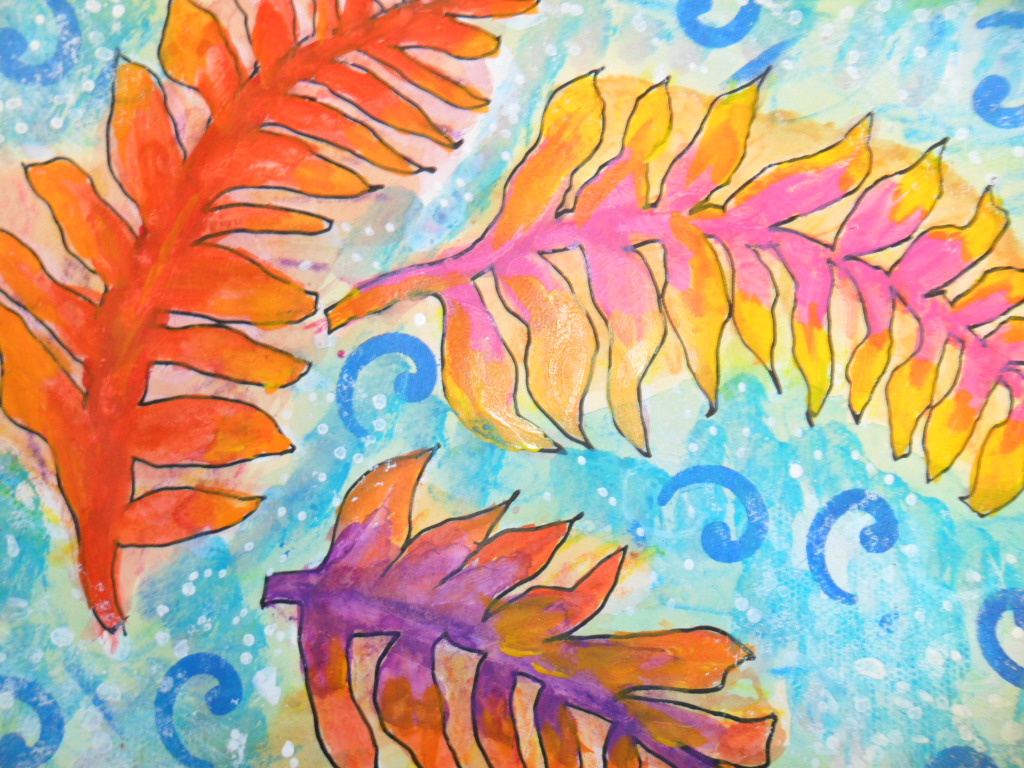
And I've taken imperfect into the studio. For the past couple days I have played with gesso and watercolor crayons and paint pens and acrylic paints and stencils and stamps to bring an imperfect vibe into my art. I don't want my art to be neat and tidy and perfect. I want it to sing, to be alive, to vibrate with energy. I want it to be full of joy. I want to create it with abandon. And I want to be able to share it without worrying whether it lives up to some standard.
This is a stretch for me. It is more comfortable to be perfect. Because if I am not perfect, then I have an excuse for not showing up. Well, it wasn't going to be perfect anyway, so why bother.
But if the goal is to be imperfect, then I can create with abandon and share without shame.
So without further adieu, may I present to you my first piece of intentionally imperfect art.
I wish you an imperfect New Year, full of messiness and fun and joy and liberation. Step out and create!
Last year I chose Serious Art as my word. I chose the word with the best of intentions. This is what I wrote at the time.
For 2011 my theme is Serious Art, which means approaching art in a deliberate and contemplative way and making sure that it becomes part of my daily routine (regardless of how hectic life seems). I'm developing a course of study for the year, for lack of a better term.I detailed a list of seven bullet points that I wanted to achieve over the year. As I looked back over the year, I realized that I didn't achieve my lofty goals. And I know why.
Serious Art was way too serious. It connected with my traits of competitiveness, thoroughness, procrastination, and perfectionism. I had it all planned out: I would read so many pages a week, create so many pieces a month, connect with so many artists a season. Every step was planned. Every lesson was scheduled. Art would become a second job that I would take seriously.
Which is exactly why I had problems. It didn't exactly fail: I did create nine pieces in a series of nine-patches, I kept an art journal through most of the year, and I took a week-long workshop with Fran Skiles that was absolutely amazing.,
But at the same time, my approach to being serious about art kept me from really creating art. Why? Because my competitive, perfectionist, and procrastinating voices would say "Hey, wait a minute! You're not doing it the right way. You have to be serious about this." Because if I wasn't being serious about my art, then what was the point?
Enough of that.
So as I was thinking about my word for 2012, only one word popped into my head.
IMPERFECT.
As soon as I thought it, I felt a great sense of relief. I knew right then that IMPERFECT is my word for 2012.
Imperfect is messy and fun. It can be beautiful. It requires acceptance (and if I can't accept something, well then that is imperfect too). It's about releasing ridiculously high standards. It's about creating with abandon, giving with joy, and offering myself without shame. Imperfect is liberation.
I've been living this word for the past week and have already noticed changes. For years, my rule has been to have a spotlessly clean house by New Year's Eve. So that has meant the week between Christmas and New Year's has been full of decluttering, vacuuming, dusting, washing floors, and other household chores. But this year that seemed really boring to me. Our house is in pretty good shape generally. And I had so many other fun things that I wanted to do.
So with imperfect in mind, I started asking myself questions. Where did that rule come from? I realized that I created it myself and had carved it into my mind as something that had to be. Did I need to keep it this year? I decided that "No, I don't need to wear myself out cleaning house this year." So I didn't clean. I tidied a bit and kept up with basic chores, but we didn't tear out the closets looking for hidden clutter and we didn't pull out the mop and buckets.
And you know what? Here we are at New Year's Eve and my house isn't spotless and I feel fine. The world has not come to an end!
And I've taken imperfect into the studio. For the past couple days I have played with gesso and watercolor crayons and paint pens and acrylic paints and stencils and stamps to bring an imperfect vibe into my art. I don't want my art to be neat and tidy and perfect. I want it to sing, to be alive, to vibrate with energy. I want it to be full of joy. I want to create it with abandon. And I want to be able to share it without worrying whether it lives up to some standard.
This is a stretch for me. It is more comfortable to be perfect. Because if I am not perfect, then I have an excuse for not showing up. Well, it wasn't going to be perfect anyway, so why bother.
But if the goal is to be imperfect, then I can create with abandon and share without shame.
So without further adieu, may I present to you my first piece of intentionally imperfect art.
I wish you an imperfect New Year, full of messiness and fun and joy and liberation. Step out and create!
Subscribe to:
Posts (Atom)